

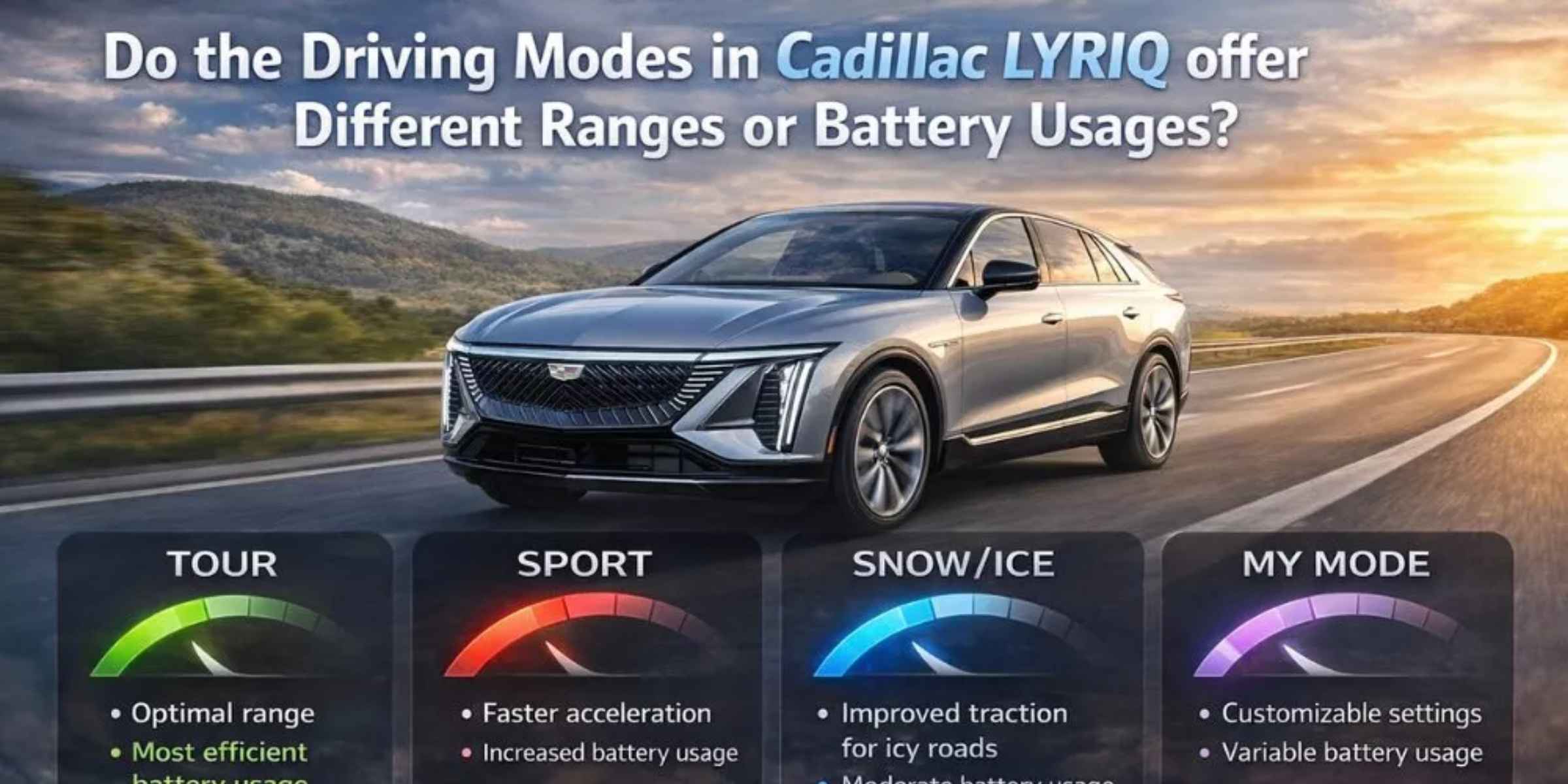
The Cadillac Lyriq is designed to deliver both luxury and electric performance, but many drivers still ask an important question: do the driving modes in Cadillac Lyriq offer different ranges or battery usages? The answer is yes. Each driving mode changes how the vehicle responds to acceleration, regenerative braking, traction control, steering feel, and power delivery. These adjustments directly influence energy consumption and real-world driving range.
Understanding how these systems work can help owners maximize efficiency, extend battery range, and improve daily driving comfort. Whether you prioritize smooth highway cruising, sporty acceleration, winter stability, or custom settings, the Lyriq gives drivers meaningful control over battery usage. This guide explains how every driving mode affects efficiency, charging habits, regenerative braking, and long-term battery performance. You will also learn practical strategies to get the best possible range from your Cadillac Lyriq in different seasons and driving conditions.
Understanding How Cadillac Lyriq Driving Modes Work
The Cadillac Lyriq uses multiple software-controlled driving modes to alter how the electric drivetrain behaves. Unlike gasoline vehicles that mainly adjust transmission shift points, EV driving modes control motor output, throttle sensitivity, energy regeneration, and traction systems. These changes can significantly influence battery usage and overall efficiency.
In the Lyriq, driving modes are integrated into General Motors’ Ultium platform. The system continuously balances power delivery and energy management based on driver input and road conditions. Tour Mode, Sport Mode, Snow/Ice Mode, My Mode, and the performance-focused V-Mode on the Lyriq-V all prioritize different characteristics.
According to public estimates and EPA testing standards, aggressive acceleration and high-performance settings typically consume more electricity. Meanwhile, smoother throttle mapping and optimized regenerative braking can improve efficiency. The result is that two drivers using different modes may see noticeably different range numbers even on the same route.
Additionally, driving modes interact with climate controls, wheel torque management, and battery conditioning systems. While these adjustments may seem subtle during short trips, they become more noticeable during highway driving, cold weather operation, or long-distance travel.
Tour Mode: Maximum Efficiency for Daily Range
Tour Mode is the default setting in the Cadillac Lyriq and is optimized for balanced comfort and efficiency. For most drivers, this mode provides the best combination of range, smooth acceleration, and predictable battery usage. Throttle response becomes gentler, helping reduce unnecessary power spikes that drain the battery faster.
Because electric vehicles deliver instant torque, even moderate acceleration can consume large amounts of energy. Tour Mode softens that initial surge, allowing the Lyriq to preserve electricity during city driving and stop-and-go traffic. Additionally, steering calibration and suspension tuning are adjusted for comfort rather than aggressive handling.
Many Lyriq owners report that Tour Mode consistently delivers the closest results to EPA-estimated range figures. This is especially true during highway cruising where steady speeds and gradual acceleration help reduce energy consumption. Regenerative braking also works more progressively in this setting, improving energy recovery without creating abrupt deceleration.
For commuters and long-distance travelers, Tour Mode is generally the smartest option when maximizing range is the primary goal. It also reduces driver fatigue because the vehicle behaves more smoothly in daily driving situations.
Sport Mode: Performance at the Cost of Range
Sport Mode transforms the Cadillac Lyriq into a more responsive and performance-oriented EV. Throttle sensitivity increases significantly, steering becomes firmer, and acceleration feels more immediate. While this creates a more engaging driving experience, it usually leads to higher battery usage.
Electric vehicles consume the most energy during rapid acceleration. In Sport Mode, the dual-motor AWD system responds aggressively to pedal inputs, drawing more power from the battery pack. Even short bursts of acceleration can noticeably reduce projected driving range.
At highway speeds, Sport Mode may also maintain more active power distribution between the front and rear motors. This enhances traction and responsiveness but can slightly decrease efficiency compared to Tour Mode. Additionally, drivers often unconsciously accelerate harder in Sport Mode simply because the vehicle feels faster and more engaging.
However, the difference in range is not always dramatic during calm driving. If a driver maintains steady speeds and avoids hard acceleration, the impact on battery consumption may remain moderate. Still, public estimates suggest that consistent use of Sport Mode can reduce overall efficiency by several percentage points over time.
For drivers who value responsiveness and dynamic handling, Sport Mode delivers a rewarding experience. However, it is not the ideal choice when maximizing EV range is the priority.
Snow / Ice Mode: Stability Over Efficiency
Snow/Ice Mode is specifically engineered for slippery road conditions. In this mode, the Cadillac Lyriq prioritizes traction, wheel stability, and controlled torque delivery instead of outright efficiency or performance. The system reduces throttle sensitivity to help prevent wheel spin during acceleration.
This mode can slightly increase battery usage because traction control systems remain more active. Additionally, cold weather itself naturally reduces EV range due to battery chemistry limitations and increased cabin heating demands. Therefore, drivers may incorrectly assume Snow/Ice Mode alone is causing major range loss.
The real advantage of this mode is stability. Torque distribution between the wheels becomes more measured, helping the vehicle maintain grip on snow-covered or icy roads. Regenerative braking behavior may also be softened to avoid sudden deceleration that could destabilize the vehicle.
Although efficiency is not the primary objective here, Snow/Ice Mode can still help preserve energy in certain winter situations. Smooth acceleration and controlled wheel movement reduce wasted energy caused by tire slip. In difficult weather conditions, maintaining control is far more important than gaining a few extra miles of range.
For drivers in northern U.S. states, this mode provides valuable confidence during winter driving without severely compromising overall battery performance.
My Mode: Custom Control Over Range and Battery Usage
My Mode allows Cadillac Lyriq drivers to personalize several vehicle characteristics. Depending on the trim and software version, drivers can adjust steering feel, acceleration responsiveness, sound enhancements, and braking preferences. This flexibility allows owners to create a balance between efficiency and performance.
One of the biggest benefits of My Mode is customization of throttle behavior. Drivers who want sharper acceleration without fully engaging Sport Mode can create a middle-ground setup. Similarly, drivers focused on efficiency can soften acceleration further while maintaining preferred steering settings.
Battery usage in My Mode depends entirely on the selected configuration. A setup with aggressive acceleration and enhanced responsiveness will consume more energy, while comfort-focused adjustments may closely resemble Tour Mode efficiency levels. This makes My Mode highly useful for adapting the vehicle to different driving environments.
Additionally, My Mode allows drivers to experiment with regenerative braking intensity. Stronger regeneration can recover more energy during urban driving, especially in stop-and-go traffic. Over time, careful customization may help drivers improve real-world efficiency without sacrificing comfort or driving enjoyment.
For many Lyriq owners, My Mode becomes the preferred everyday setting because it offers flexibility that standard presets cannot fully provide.
V-Mode and Velocity Max — Exclusive to Lyriq-V
The high-performance Cadillac Lyriq-V introduces advanced driving features designed for maximum acceleration and dynamic performance. V-Mode is a customizable high-performance setting that sharpens nearly every aspect of the vehicle’s behavior, including power delivery, suspension tuning, steering response, and sound design.
Velocity Max unlocks the vehicle’s highest acceleration capability. In this configuration, battery energy is prioritized for performance rather than efficiency. Instant torque delivery becomes far more aggressive, which naturally increases electricity consumption during spirited driving.
According to Cadillac performance specifications, the Lyriq-V targets sports sedan levels of acceleration despite being a luxury electric SUV. However, achieving that level of performance requires substantial battery output. Drivers using V-Mode frequently will typically see lower real-world range compared to standard driving modes.
Thermal management systems also work harder during repeated high-performance driving. Battery cooling, motor temperature regulation, and power electronics consume additional energy to maintain consistent output. While the Ultium battery platform is engineered for these demands, efficiency is no longer the primary focus.
For enthusiasts, V-Mode showcases the impressive capabilities of Cadillac’s electric performance engineering. Still, drivers seeking maximum range should reserve these settings for occasional spirited driving rather than daily commuting.
Driving Mode Comparison: Range and Efficiency at a Glance
Each Cadillac Lyriq driving mode serves a distinct purpose, and understanding their differences helps drivers make smarter efficiency decisions. Tour Mode generally delivers the best overall balance between comfort and battery conservation. Sport Mode sacrifices some efficiency for sharper performance, while Snow/Ice Mode prioritizes traction and safety.
My Mode offers a customizable approach that can either mimic efficiency-focused behavior or lean toward sportier characteristics. Meanwhile, V-Mode on the Lyriq-V represents the highest-performance configuration and naturally consumes the most energy under aggressive driving conditions.
Real-world range differences depend heavily on driver habits. A calm driver using Sport Mode may still achieve respectable efficiency, while aggressive acceleration in Tour Mode can dramatically reduce range. Environmental conditions, tire pressure, road elevation, HVAC usage, and vehicle load all contribute to battery consumption as well.
In general, many EV experts estimate that efficient driving habits matter more than mode selection alone. However, the selected driving mode strongly influences how easily efficient driving can be maintained throughout daily operation.
⚙️ How Regenerative Braking and One-Pedal Driving Change Everything
Regenerative braking is one of the most important efficiency technologies in the Cadillac Lyriq. Instead of wasting energy as heat during braking, the electric motors convert kinetic energy back into stored electricity. This recovered energy helps extend driving range.
One-Pedal Driving takes this concept further by allowing drivers to slow the vehicle primarily through regenerative braking rather than traditional brake pedal use. In urban environments, this can significantly improve efficiency because the system continuously captures energy during deceleration.
The Lyriq’s regenerative braking system is especially effective in stop-and-go traffic. Frequent slowing events create more opportunities for energy recovery. Drivers who master smooth One-Pedal Driving techniques often achieve better efficiency than those relying heavily on conventional braking.
Additionally, regenerative braking reduces wear on mechanical brake components. Brake pads and rotors typically last longer in EVs because much of the deceleration force comes from the electric motors instead of friction brakes. This creates both efficiency and maintenance advantages over time.
Mode-Specific Regen Behavior
Regenerative braking behavior changes depending on the selected driving mode. In Tour Mode, regen is usually calibrated for smoothness and comfort. The transition between acceleration and deceleration feels gradual, which improves everyday drivability.
Sport Mode often increases regenerative braking intensity slightly to match the more aggressive driving character. This stronger deceleration can help drivers maintain control during spirited driving while recovering additional energy during rapid speed changes.
Snow/Ice Mode may reduce sudden regenerative braking effects to avoid traction loss on slippery surfaces. Abrupt deceleration on ice or snow could destabilize the vehicle, so the system prioritizes smoothness and control instead of maximum energy recovery.
Drivers using My Mode can often personalize regenerative braking preferences. This customization allows owners to optimize the balance between efficiency, comfort, and responsiveness based on individual driving styles and road conditions.
What Actually Determines Real-World Battery Usage?
While driving modes matter, they are only one factor affecting Cadillac Lyriq battery usage. Speed remains one of the largest influences on EV efficiency. Highway driving above 70 mph significantly increases aerodynamic drag, which rapidly consumes energy.
Temperature also plays a major role. Cold weather reduces battery efficiency and increases cabin heating demands. Hot climates may require more battery cooling and air conditioning usage. Both conditions affect overall range regardless of driving mode selection.
Tire pressure, wheel size, passenger weight, cargo load, road elevation, and driving habits further influence energy consumption. Aggressive acceleration, frequent hard braking, and rapid lane changes all increase electricity usage. Even headwinds can reduce range during long highway trips.
Software optimization is another factor. Modern EVs continuously update battery management systems, regenerative braking calibration, and thermal controls through over-the-air updates. These improvements can slightly enhance efficiency over time without changing hardware components.
Ultimately, real-world range depends on a combination of driving conditions, vehicle settings, and driver behavior rather than any single mode alone.
🌦️ Seasonal Driving Strategies for Maximum Range
Seasonal changes can dramatically affect Cadillac Lyriq efficiency. During winter, battery chemistry becomes less efficient, reducing available range. Preconditioning the battery while plugged in can help maintain performance before starting a trip.
Using heated seats and steering wheel functions instead of maximum cabin heat can also preserve battery energy. Additionally, smooth acceleration in cold weather improves traction and reduces unnecessary power consumption.
In summer, excessive cabin cooling can increase electricity usage. Parking in shaded areas and using remote climate preconditioning while charging helps reduce air conditioning load once driving begins.
Rain and strong winds also influence EV range. Wet roads increase rolling resistance, while headwinds create additional aerodynamic drag. Adjusting driving style during challenging weather conditions can help maintain more consistent efficiency throughout the year.
10 Proven Tips to Maximize Your Cadillac Lyriq Range
- Use Tour Mode for most daily driving situations.
- Avoid aggressive acceleration whenever possible.
- Maintain recommended tire pressure levels.
- Use One-Pedal Driving in city traffic.
- Precondition the cabin while plugged in.
- Limit high-speed highway driving when practical.
- Reduce unnecessary cargo weight.
- Keep software updates installed.
- Use seat heaters instead of maximum cabin heat in winter.
- Plan charging stops strategically during long trips.
These strategies can meaningfully improve real-world range without sacrificing comfort or convenience. Small adjustments in driving behavior often produce larger efficiency gains than mode selection alone.
Consistency also matters. Drivers who combine efficient habits with smart mode usage typically experience the best overall battery performance and charging efficiency over time.
Do Driving Modes Affect Long-Term Battery Health?
Driving modes can influence battery stress levels, but modern EV battery systems are designed to handle varied operating conditions safely. Frequent aggressive acceleration in Sport Mode or V-Mode creates higher heat generation inside the battery pack, which may slightly increase long-term wear.
However, Cadillac’s thermal management system actively regulates battery temperature to minimize degradation risks. According to industry research, temperature extremes and repeated fast charging usually have a larger impact on long-term battery health than driving mode alone.
Tour Mode generally places less demand on the battery because power delivery is smoother and more controlled. Drivers focused on long-term efficiency often prefer this setting for daily use.
Maintaining healthy charging habits, avoiding prolonged extreme temperatures, and keeping the battery between moderate charge levels during daily driving are usually more important than worrying about occasional Sport Mode usage.
📏 What the EPA Range Rating Actually Means
EPA range ratings provide standardized estimates under controlled testing conditions. These figures help consumers compare EV efficiency, but real-world results can vary significantly depending on weather, speed, terrain, and driving style.
The Cadillac Lyriq’s EPA-rated range is typically achieved under balanced driving conditions using moderate acceleration and efficient climate control usage. Driving aggressively in Sport Mode or V-Mode will usually reduce real-world range below EPA estimates.
Conversely, careful driving in Tour Mode with effective regenerative braking can sometimes exceed official estimates under favorable conditions. This is especially true during mild weather and urban driving environments.
Understanding EPA ratings as benchmarks rather than guarantees helps drivers set realistic expectations. Driving modes are one part of the larger efficiency equation that determines actual battery performance.
📡 The Role of Over-the-Air Software Updates
Over-the-air software updates play a growing role in EV efficiency optimization. Cadillac can improve energy management systems, regenerative braking calibration, charging performance, and thermal control algorithms without requiring dealership visits.
Some updates may refine how driving modes behave under certain conditions. For example, smoother throttle mapping or improved regen tuning could slightly increase efficiency during everyday driving.
Battery preconditioning strategies may also improve through software optimization. These changes help the vehicle maintain more consistent charging speeds and energy usage in different climates.
Because EV technology evolves rapidly, keeping software updated ensures the Cadillac Lyriq continues operating with the latest performance and efficiency improvements available from the manufacturer.
🔌 How Driving Mode Choice Affects Your Charging Routine
Driving modes directly influence how frequently drivers need to charge. Consistent use of Sport Mode or V-Mode increases energy consumption, reducing the distance traveled per charge cycle. Drivers may find themselves charging more often during weeks of aggressive driving.
Tour Mode usually stretches battery range further, allowing longer intervals between charging sessions. This can be especially useful for commuters or road-trip travelers trying to minimize charging stops.
Charging behavior also affects convenience and battery longevity. Drivers using high-performance modes regularly may rely more heavily on DC fast charging during trips, which generates additional heat inside the battery pack.
Balancing performance and efficiency based on driving needs helps create a more predictable charging routine. Many owners reserve performance-focused modes for short recreational drives while using Tour Mode for daily commuting and long-distance travel.
🎯 Conclusion: Smart Mode Selection Unlocks Your Lyriq’s Full Potential
So, do the driving modes in Cadillac Lyriq offer different ranges or battery usages? Absolutely. Each mode changes how the vehicle delivers power, manages regenerative braking, and responds to driver input. Tour Mode typically delivers the best efficiency, while Sport Mode and V-Mode prioritize acceleration and responsiveness at the expense of range. Snow/Ice Mode focuses on traction and safety, and My Mode allows drivers to create a personalized balance between comfort and performance.
However, driving habits, weather, speed, and charging practices ultimately play an even larger role in real-world battery usage. By understanding how these systems interact, Cadillac Lyriq owners can maximize efficiency, improve long-term battery performance, and enjoy a more refined EV driving experience tailored to their specific needs.
Frequently Asked Questions
Does Sport Mode reduce range in the Cadillac Lyriq?
Yes. Sport Mode increases throttle responsiveness and power delivery, which usually leads to higher battery usage and reduced driving range compared to Tour Mode.
Which driving mode gives the best battery efficiency in the Lyriq?
Tour Mode generally provides the best overall efficiency because it prioritizes smooth acceleration, balanced power usage, and comfortable driving behavior.
Is One-Pedal Driving better for battery range?
Yes. One-Pedal Driving increases regenerative braking opportunities, helping recover energy during deceleration and improving efficiency in city driving.
Does cold weather affect Cadillac Lyriq battery range?
Cold temperatures reduce EV battery efficiency and increase cabin heating demands. Range loss during winter is normal for most electric vehicles.
Can My Mode improve real-world efficiency?
It can. Drivers can customize acceleration and regenerative braking settings to create a more efficient driving experience that matches their habits and road conditions.

Nathan Cole writer at BlessingsShine, dedicated to creating heartfelt blessings, prayers, and inspirational messages that uplift and guide readers. With years of experience, he blends empathy, spiritual insight, and practical wisdom to help people find comfort, positivity, and clarity in everyday life. Nathan’s work is designed to inspire hope, strengthen connections, and provide meaningful words that readers can use in personal reflection or to share with others.